An alternative to a full S/4HANA upgrade
A full S/4HANA programme usually carries more than the ERP. Commerce feeds, the customer 360, consent and audiences move with it, often onto SAP’s add-ons or onto Salesforce. This page describes the other route: move the data that faces customers and Google out of ECC into Xano and Cloudflare now, and leave finance and logistics for the ERP migration.
It is an alternative to the scope of the upgrade, not to the upgrade itself. ECC support still ends, and FI/CO, MM, SD pricing and tax still need a supported ERP.
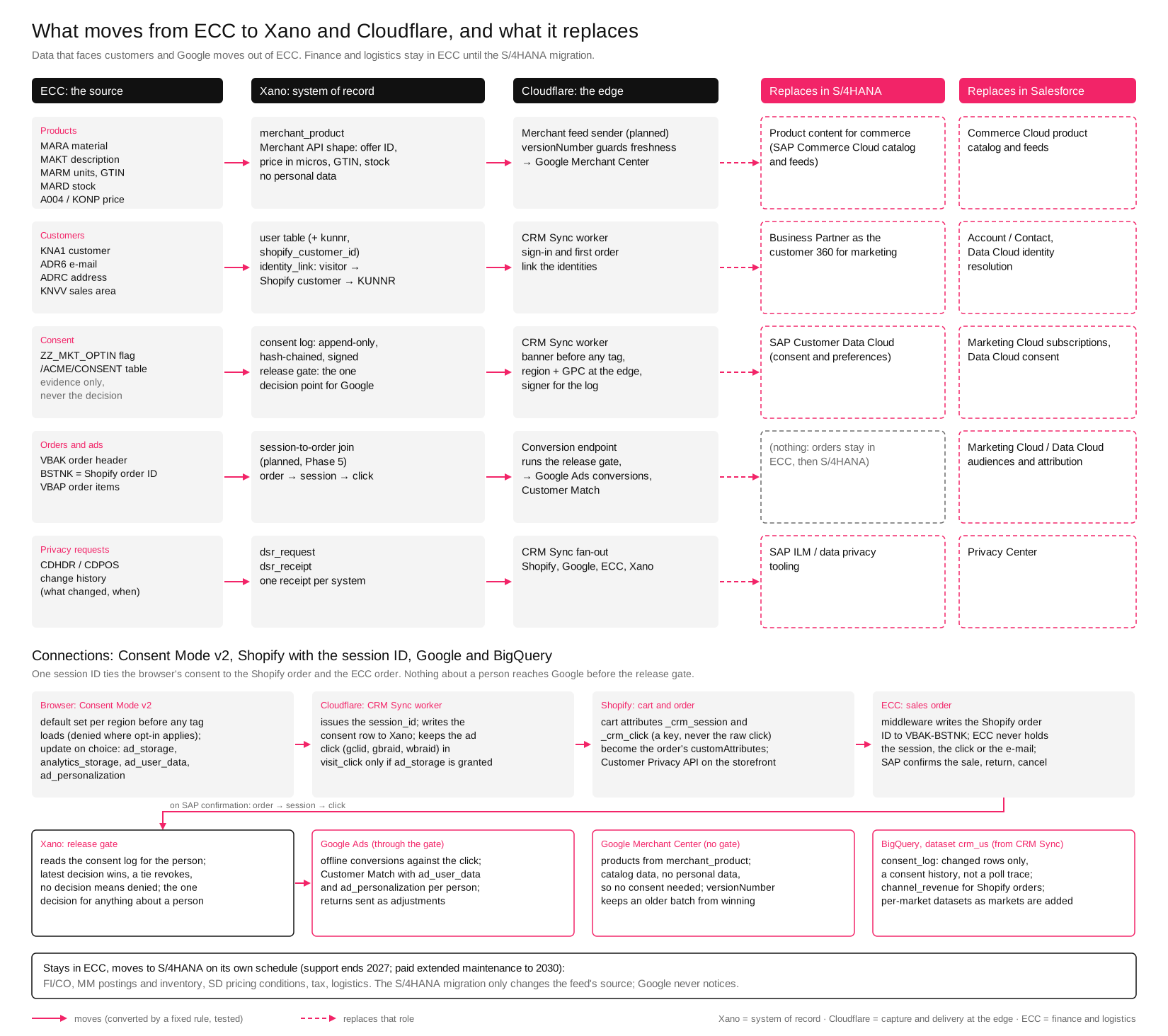
What moves
| Data | From ECC | Into Xano | At the Cloudflare edge | Role it replaces |
|---|---|---|---|---|
| Products | MARA, MAKT, MARM, MARD, A004 / KONP | merchant_product, in the Merchant API shape | Merchant feed sender (planned) | Commerce catalog and feeds |
| Customers | KNA1, ADR6, ADRC, KNVV | The user table and identity_link | CRM Sync links visitor, Shopify customer and KUNNR | Customer 360 for marketing |
| Consent | ZZ_MKT_OPTIN, /ACME/CONSENT, as evidence only | The consent log and the release gate | CRM Sync: banner, region, GPC, signer | Consent and preference management |
| Orders and ads | VBAK / VBAP, with the Shopify order ID in BSTNK | The session-to-order join (planned) | Conversion endpoint, behind the release gate | Audiences and attribution |
| Privacy requests | CDHDR / CDPOS change history | dsr_request, dsr_receipt | CRM Sync fans each request out | Privacy request tooling |
Orders themselves don’t move: the order stays in ECC, and only its reference rides to Google. ECC direct to Google explains why the product and people flows are kept apart.
Connections: Consent Mode v2, Shopify with the session ID, Google and BigQuery
One session ID ties the browser’s consent to the Shopify order and the ECC order. Nothing about a person reaches Google before the release gate.
| Step | Where | What |
|---|---|---|
| 1 | Browser | Consent Mode v2 sets its default per region before any tag loads (denied where opt-in applies), then updates on the shopper’s choice: ad_storage, analytics_storage, ad_user_data, ad_personalization. |
| 2 | Cloudflare: CRM Sync worker | Issues the session_id and writes the consent row to Xano. Keeps the ad click (gclid, gbraid, wbraid) in visit_click only if ad_storage is granted. |
| 3 | Shopify | Cart attributes _crm_session and _crm_click (a key, never the raw click ID) become the order’s customAttributes. The storefront reads the Customer Privacy API. |
| 4 | ECC | Middleware writes the Shopify order ID to VBAK-BSTNK. ECC never holds the session, the click or the e-mail. SAP confirms the sale, return or cancellation. |
| 5 | Xano: release gate | On SAP’s confirmation, order → session → click, then the gate reads the person’s consent: latest decision wins, a tie revokes, no decision means denied. |
| Destination | Through the gate? | What goes |
|---|---|---|
| Google Ads | Yes | Offline conversions against the click; Customer Match with ad_user_data and ad_personalization per person; returns as adjustments. |
| Google Merchant Center | No: no personal data | Products from merchant_product. versionNumber keeps an older batch from overwriting a newer one. |
BigQuery, dataset crm_us | Streamed by CRM Sync | consent_log with changed rows only (a consent history, not a poll trace) and channel_revenue for Shopify orders. Per-market datasets are added as markets are. |
Steps 2 to 5 for the ad click are the session-to-order join in Plan: Xano buildout, which is planned, not live.
Benefits
- Google and Shopify now, not after the migration. Products reach Merchant Center from the ECC data that exists today. Nothing waits for a go-live date.
- A smaller S/4HANA project. Catalog content, consent, identity and audiences are out of scope. The migration is the finance and logistics core, which is the part SAP’s support dates actually force.
- The commerce side doesn’t notice the migration. Offer IDs, Google’s product history, the consent log and the identity links all live outside the ERP. When ECC is replaced, only the source of the mapping changes. Most of the tables used here keep their names in S/4HANA (MARA, MAKT, KNA1, VBAK, VBAP, KONP), and those that don’t, such as MARD, are read through compatibility views. This book is generated from the DD03L export, so an S/4HANA export regenerates it.
- Fewer add-on licences for these roles. The roles in the diagram don’t need a separate consent product, a separate customer data platform or a second CRM. What each would cost is outside this book.
- One consent decision. Every payload to Google passes one release gate, reading one append-only, hash-chained log. Two systems can’t disagree about the same person, and the log is the evidence when a regulator asks.
- The facts stay fixed. Identifiers, amounts, units, dates and stock are converted by fixed, tested rules
(
src/merchant.rs,tests/). Nothing generated rewrites them, in ECC or after it.
The alternatives
| Route | What it means | When Google and consent work | What to weigh |
|---|---|---|---|
| Full S/4HANA with SAP’s add-ons | ERP, commerce, customer data and consent move together, onto S/4HANA and SAP’s commerce and consent products | At go-live | The largest scope, one go-live date for everything, and add-on licences |
| S/4HANA plus Salesforce | ERP onto S/4HANA; customers, consent and audiences onto Salesforce | At go-live, plus the CRM integration | Two vendors’ data models for the same person, and an integration between them |
| ECC plus Xano and Cloudflare now, S/4HANA core later | The route on this page | Now | A layer to run alongside ECC; the ERP migration still has to happen |
| Stay on ECC longer | Paid extended maintenance (to 2030) or third-party support | Only if a layer like this one is added | Support cost and a fixed horizon; the layer works the same either way |
The third and fourth routes combine: the layer doesn’t depend on when, or whether, the ERP moves.
Substitutes at the edge
Without an S/4HANA upgrade, and without buying a server-based application, ECC can stay as it is while the front ends change. Cloudflare Workers run the Rust gate compiled to WebAssembly in front of ECC. Each modern front end is a substitute that plugs into that one gate, so it can be swapped without touching ECC or the rules.
 Front ends (substitutes, swappable)
 Fiori-style UI5 app · AEM page or edge function · Xano + CRM plugin · a form
                    │
                    ▼
 Cloudflare: Workers + the Rust gate (WebAssembly)
   verify · parse into typed records · decide (consent, purpose, region) · receipt
                    │
     ┌──────────────┼───────────────────┐
     ▼              ▼                   ▼
 ECC (unchanged)   Xano (system of      Shopify · Google · BigQuery
 via a tunnel →    record: consent,     (destinations, after the gate)
 OData / RFC /     ledger, crosswalk)
 IDoc, read-mostly
| Substitute | Replaces | How it connects | Catch |
|---|---|---|---|
| Fiori-style UI5 app at the edge | New S/4HANA Fiori apps | Static UI5 served by a Worker, calling ECC’s OData services (SAP Gateway) through the gate | ECC has fewer, older OData services than S/4HANA; some screens need a custom service or a read model in Xano |
| AEM page or AEM edge function | A commerce or content front end tied to the ERP upgrade | AEM renders; the gate decides what data and which tags reach it | Adobe’s edge features differ by AEM product and licence: check what is licensed |
| Xano connected to BAU systems or a CRM plugin | New S/4HANA objects, a CDP or a new CRM | Xano holds consent, the ledger and the crosswalk; plugins read through the gate | Xano becomes core infrastructure: it needs an owner, backups and a region per regime |
| A form | A custom ABAP transaction or a portal | A Worker validates it, the gate decides, Xano records it; ECC receives a document only if it truly needs one | Every document written to ECC counts under Digital Access |
Why it holds without an upgrade
- ECC stays the source of identity and blocking. Its core doesn’t change, and consent never lives in it (Consent gaps).
- The rules travel as one crate. Rust compiled to WebAssembly runs in the Worker, browser islands, Shopify Functions and batch jobs, with one owner per decision (Parsing at the gate).
- ECC is reached without opening it. A tunnel from the ECC network out to Cloudflare (for example Cloudflare Tunnel) means no inbound ports; the gate is the only route in.
- Substitutes are swappable. Fiori, AEM, a Xano screen and a form all call the same gate. Changing the front end changes nothing in ECC or in the rules.
Conditions to state plainly
- Read-mostly. Reading ECC carries little exposure under Digital Access; orders, returns or form submissions written back into ECC are counted. Settle the licence model first (Licensing penalties by flow).
- ECC’s support clock still runs. This buys time and moves value out of ECC; it does not extend ECC’s maintenance (see below).
- SAP doesn’t support the edge layer. The gate, the Worker and Xano are yours to run: each needs an owner, an availability target and a defined failure mode (Function gating).
- ECC’s interfaces set the limit. Data with no OData service, RFC module or IDoc needs one built in ECC: ABAP work.
- Each platform’s own rules still apply. Shopify’s IP allowlist and expiring tokens, and the exempt, permanent custom-app tokens on ERP links (Shopify’s deadlines).
The rule: ECC stays where it is, mostly read; Cloudflare and the Rust gate sit in front; consent and decisions live in Xano; front ends are substitutes that all call the same gate; and every write back to ECC is a licence question settled before it ships.
What this doesn’t replace
- The ERP. FI/CO, MM postings and inventory, SD pricing conditions, tax and logistics stay in ECC until they move to S/4HANA or another ERP.
- The support deadline. Standard maintenance for ECC ends at the end of 2027; paid extended maintenance runs to 2030.
- The consent check for people. Customer data reaches Google only through the release gate. ECC’s opt-in flags are evidence for it, never the decision.
- Work still to be built. The Merchant feed sender and the session-to-order join are planned, not live. See Plan: Xano buildout.